Let’s kill one of the biggest myths in America right now.
The Black community is not poor by nature.
What we are is structurally underpaid, economically excluded, and systematically blocked from ownership.
And the numbers prove it.
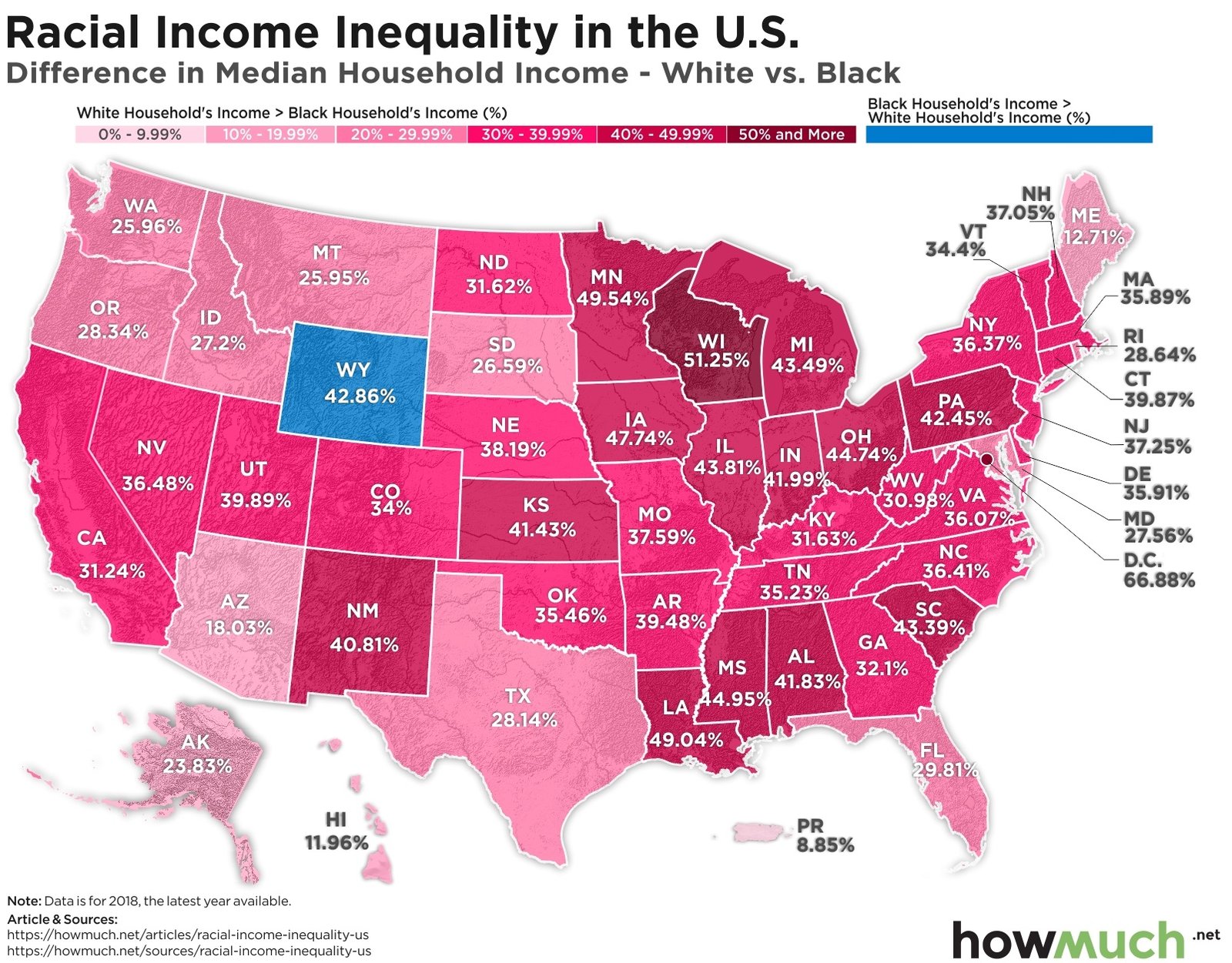
Across almost every state in America, African American workers earn less than white workers doing comparable labor. In fact, Wyoming is often cited as the only state where median income for Black workers slightly exceeds that of white workers — largely due to unique demographics and a very small sample size.
Everywhere else?
The gap is real. And it’s persistent.
The Inequality Starts at the Paycheck
Before we even talk about spending habits or “financial discipline,” we have to confront the starting line.
Black workers:
- They are paid less on average
- Accumulate less generational wealth
- Face higher barriers to promotions and leadership
- Are more likely to work essential but undervalued jobs
So when people ask why wealth doesn’t build the same way, they’re ignoring the fact that we’re running uphill from day one.
Yet even with these disadvantages, Black America still generates trillions of dollars in annual economic activity. That alone should stop the conversation.
If we were truly “broke,” that wouldn’t be possible.
The Real Problem: Circulation, Not Capability
Here’s where the system tightens its grip.
In many communities, money circulates for weeks or months before leaving. In Black communities, studies and estimates often show it circulates for hours or days.
Not because we’re reckless — but because:
- We don’t own enough stores in our neighborhoods
- We don’t control supply chains
- We don’t control housing at scale
- We don’t control banks or capital access
- We don’t control media narratives
So even when we do earn, the system is designed to extract.
We pay rent to someone else.
We buy food from someone else.
We wear brands we don’t own.
We stream platforms we don’t control.
The money leaves before it ever gets a chance to work for us.
Ownership Is How You Break Income Inequality
Income alone doesn’t create power.
Ownership does.
That’s the part we’ve been systematically denied — not just historically, but right now.
Ownership of:
- Businesses
- Land and housing
- Manufacturing
- Technology
- Food systems
- Media
- Transportation
- Intellectual property
When you don’t own, you’re always dependent — no matter how talented you are.
And make no mistake: talent has never been the issue.
Skill, Talent, and Genius Are Not in Short Supply
Black and Brown people:
- Build America’s culture
- Power its labor force
- Dominate entertainment and sports
- Drive innovation in tech, medicine, and engineering
- Serve at the highest levels of military and public service
We create value constantly — yet capture very little of the long-term upside.
That’s not a lack of ability.
That’s a lack of access, education, and equity.
This Is a Call for an Economic Awakening
Not violence.
Not chaos.
Not destruction.
An economic uprising.
One rooted in:
- Ownership over optics
- Cooperation over competition
- Long-term planning over short-term flexes
That means:
- Supporting Black-owned businesses consistently
- Teaching financial literacy early and often
- Pooling resources instead of fragmenting them
- Investing locally, not just spending locally
- Valuing trades, land ownership, and equity as much as fame
Real revolutions don’t always look loud.
Some look like:
- Community land trusts
- Cooperative businesses
- Credit unions
- Investment groups
- Board seats instead of brand deals
Knowledge Isn’t Enough — It Has to Be Applied
We’ve reached the era where information is everywhere.
What’s missing is application.
Knowing how money works.
Knowing how to protect assets.
Knowing how to scale businesses.
Knowing how to pass wealth forward instead of resetting every generation.
When knowledge spreads and gets used, systems crack.
The Bottom Line
Racial income inequality isn’t an accident.
The lack of ownership isn’t a coincidence.
And the idea that Black America lacks discipline is a lie.
The power exists.
The talent exists.
The money exists.
What determines the future is whether we decide to keep it, grow it, and protect it.
This isn’t about waiting for fairness.
It’s about building leverage.
And that starts the moment we choose ownership over extraction — together.